


Overview of Leak and Seal Strength Tester
Package integrity plays a critical role in protecting products throughout storage, transportation, and distribution. The leak and seal strength tester is designed to evaluate the sealing performance and structural integrity of flexible and rigid packages by using internal pressurization and pressure decay testing methods. This testing approach helps manufacturers identify weak seals, material defects, and potential leakage risks before products reach the market.
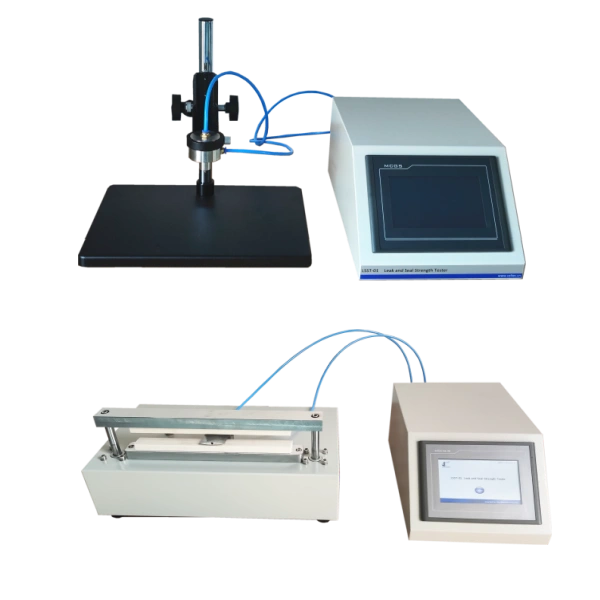
For industries such as food packaging, pharmaceutical packaging, medical devices, and specialty packaging, maintaining consistent seal quality is essential for product safety and regulatory compliance. The LSST-01 Leak and Seal Strength Tester from Cell Instruments applies the 圧力減衰法 to analyze package performance and supports testing requirements related to ASTM F2054 そして ASTM F1140 の基準を満たす。.
What Is a Leak and Seal Strength Tester?
A leak and seal strength tester is a professional laboratory instrument used to evaluate package sealing reliability by applying internal air pressure and monitoring pressure changes over time. Unlike traditional visual inspection methods, this testing approach provides quantitative data about package strength, leakage behavior, and failure characteristics.
The instrument is commonly used for:
- フレキシブルポーチとバッグ
- Medical device packages
- Pharmaceutical containers
- 食品・飲料包装
- Cosmetic packaging
- Tubes and specialty containers
- Industrial flexible packaging
By measuring how a package responds to controlled internal pressure, engineers can determine whether the sealing system meets quality requirements and production specifications.
Why Is Package Seal Integrity Testing Important?
Package seals serve as the primary barrier protecting products from contamination, moisture, oxygen exposure, and product loss. Even small sealing defects can compromise product quality, especially in sterile medical packaging, pharmaceutical applications, and modified atmosphere packaging (MAP).
A reliable seal integrity testing process helps manufacturers:
- Verify sealing process consistency
- Detect weak areas in packaging structures
- Reduce product recalls caused by leakage failures
- Optimize sealing temperature, pressure, and time parameters
- Support regulatory compliance
- Improve packaging development and validation
For companies developing new sustainable packaging materials or lightweight packaging solutions, seal performance evaluation becomes increasingly important because thinner materials may require more precise quality control.
How Does the Pressure Decay Leak Test Method Work?
の pressure decay leak test method uses internal pressurization to evaluate whether a package can maintain a stable pressure level after inflation.
The basic principle includes:
- パッケージ Pressurization: The test sample is connected to the inflation system, and compressed air is introduced into the package. The internal pressure gradually increases until reaching the preset test value.
- Pressure Stabilization: After reaching the target pressure, the system allows pressure stabilization to eliminate the influence of material expansion and temperature variation.
- Pressure Monitoring: The tester continuously monitors pressure changes inside the package. If leakage occurs, internal pressure decreases over time.
- Result Evaluation: The pressure loss value, holding time, and failure condition are recorded to evaluate package integrity.
A faster pressure drop usually indicates a larger leak or weaker seal performance, while stable pressure retention indicates better package integrity.
Standard of Pressure Decay Method
Different packaging structures require different leak detection technologies. The 圧力減衰法 provides advantages for packages that can be internally pressurized.
| 標準 | 試験方法 | Testing Principle | Typical Application |
|---|---|---|---|
| ASTM F2054 | Internal Pressurization Burst Testing of Flexible Packages | Apply internal air pressure to the package and evaluate seal strength and package failure behavior | Flexible pouches, bags, medical packages, sterile barrier systems |
| ASTM F1140 | Internal Pressurization Failure Resistance Testing | Increase internal pressure or maintain pressure to evaluate burst, creep, and creep-to-failure performance | Flexible and semi-rigid packages, pharmaceutical and food packaging |
Related Tester And Test Method
| Instrument Name | Applicable Standards | 試験方法 |
|---|---|---|
| Leak and Seal Strength Tester (LSST) | ASTM F2054, ASTM F1140 | Pressure Decay Method (Internal Pressurization Method) |
| Leak Tester (LT Series) | ASTM F2338 | 真空崩壊法 |
| Gross Leak Tester (GLT) | ASTM F2096 | Internal Pressurization Bubble Detection Method |
| Micro Leak Tester (MLT) | ASTM F2338 | High-Sensitivity Vacuum Decay Method |
Leak and Seal Strength Tester Testing Principles
The LSST-01 supports multiple internal pressure testing modes, including burst testing, creep testing, and creep-to-failure testing.
バーストテスト
Burst testing increases internal pressure continuously until the package fails.
During the test:
- Pressure gradually increases
- The system monitors package response
- The maximum pressure before failure is recorded
The burst pressure indicates the maximum structural strength of the package.
Test Result:
- Maximum burst pressure
- Failure location
Burst testing helps engineers understand the ultimate strength limit of packaging structures.
クリープ試験
Creep testing evaluates long-term package performance under constant pressure.
The package is normally pressurized below the burst pressure level, commonly around 80% of the burst value. The system maintains pressure for a defined period while monitoring deformation and pressure stability.
Test Result:
- Applied internal pressure
- Holding time
This method helps simulate packaging stress during transportation and storage.
クリープ破壊試験
The creep-to-failure test applies continuous pressure until package failure occurs. The pressure level is typically higher than the creep test condition, often around 90% of burst pressure.
Test Result:
- 印加圧力
- Time until failure
This test provides valuable information about package durability under demanding conditions.
Applications Across Different Industries
The pressure decay leak testing approach is widely used in industries where package reliability is critical.
食品包装
Applications include:
- Vacuum packaging
- Modified atmosphere packaging
- Flexible pouches
- Retort packaging
Testing helps maintain food freshness and prevents contamination.
医薬品包装
Pharmaceutical manufacturers use seal integrity testing to verify:
- Drug protection
- Packaging consistency
- 規制遵守
医療機器包装
Sterile medical packaging requires reliable seals to maintain barrier performance throughout the product lifecycle. Leak and seal strength testing supports validation procedures according to ISO 11607 requirements.
Cosmetic and Specialty Packaging
Tubes, sachets, and flexible containers require consistent sealing performance to prevent leakage during transportation and consumer use.
Technical Features of LSST-01 Leak and Seal Strength Tester
The LSST-01 provides flexible testing solutions for different package designs.
Key specifications include:
| パラメータ | Specification |
|---|---|
| テスト範囲 | 0–600 kPa |
| Open Pack Jig | 300 mm standard |
| 膨らませるヘッド | Φ4 mm |
| 圧縮空気 | 0.4–0.7 MPa (prepared by user) |
| Power Supply | AC 110–220V, 50/60Hz |
The instrument supports customized fixtures for different package formats, including:
- Sachets
- Bags
- Pouches
- Tubes
- Bottles
- ドイパック
- ジャンボバッグ
- Battery packaging
Customized fixtures allow laboratories and manufacturers to adapt the system for unique package designs and specialized testing requirements.
Choosing the Right Leak Testing Equipment
When selecting a leak testing system, engineers should consider:
- Package material and structure
- Required testing standard
- Leak detection sensitivity
- Destructive or non-destructive testing requirements
- Production quality control needs
For flexible packages requiring seal strength evaluation, the leak and seal strength tester using the pressure decay method provides reliable quantitative results and supports ASTM F2054 and ASTM F1140 testing requirements.
Cell Instruments provides standard testing instruments, customized fixtures, and application-specific testing solutions to help laboratories and manufacturers improve packaging quality control.
Summary
The Leak and Seal Strength Tester is a professional package integrity testing instrument that evaluates seal performance through internal pressurization and pressure decay analysis. It measures burst pressure, creep performance, and creep-to-failure behavior for flexible and rigid packaging applications. Designed for food, pharmaceutical, medical, cosmetic, and industrial packaging, the system supports ASTM F2054 and ASTM F1140 testing methods with customizable fixtures for different package structures.
Cell Instruments provides advanced leak and seal strength testing solutions based on pressure decay technology, including standard instruments and customized fixtures for different packaging formats. Contact our technical team to explore suitable testing solutions for your packaging validation, quality control, and research requirements.
 EN_GB
EN_GB  BG
BG  CS
CS  DA
DA  EL
EL  ET
ET  FI
FI  HU
HU  IT
IT  LT
LT  LV
LV  NB
NB  NL
NL  PL
PL  PT
PT  RO
RO  SK
SK  SL
SL  SV
SV  TR
TR  UK
UK  EN
EN  VI
VI  TH
TH  AZ
AZ  BE
BE  BN
BN  BS
BS  CA
CA  FA
FA  HE
HE  HI
HI  HR
HR  HY
HY  JV
JV  KK
KK  SQ
SQ  SR
SR  AF
AF  CY
CY  AS
AS  CEB
CEB  DZ
DZ  EU
EU  KA
KA  SI
SI  TL
TL  SW
SW  PS
PS